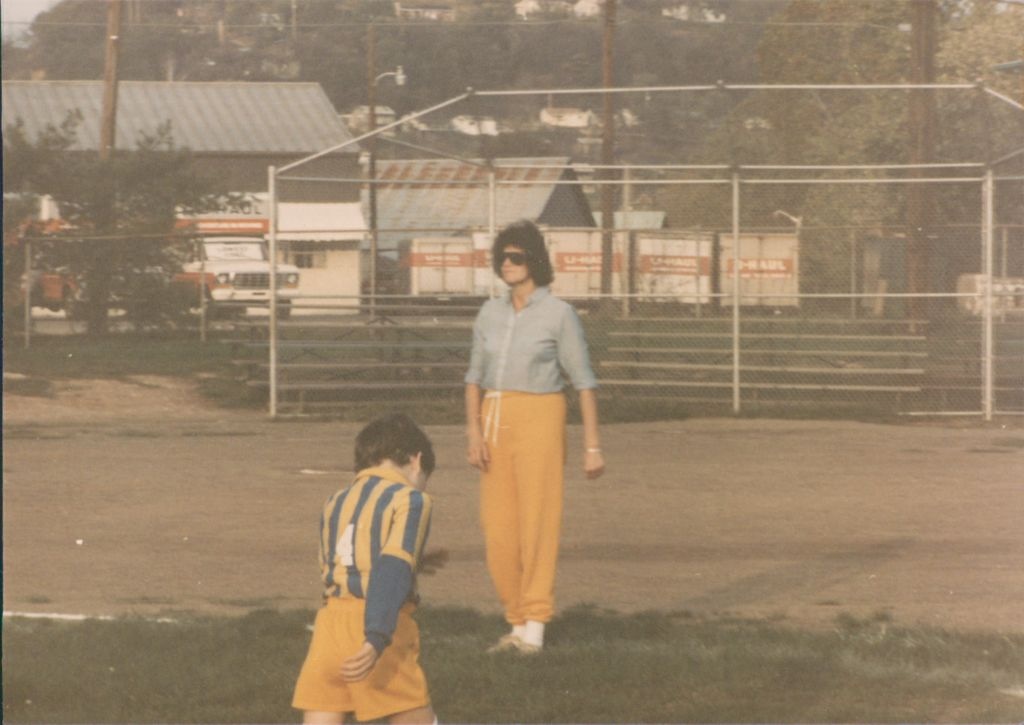
Coach Kathy

Tuesday, 16 October 2012.

Tonight the U.S. National Men’s Soccer Team plays a World Cup Qualifying soccer match. They play Guatemala. Win or tie and they move on to the next round of World Cup qualifying.

I love soccer. I played when I was a kid. I was a West Side Wildcat.

When I was five years old my father was asked to coach soccer on the West Side of Charleston. He already coached t-ball, little league baseball and basketball; he seemed like a perfect fit.

In preparation for his inaugural season he visited the library and skimmed a book on soccer. From this book he remembered three fundamental skill drills. The 7 years of practices following the team only ran those three drills. I didn’t know there were more than three basic skill drills in soccer until I had a different coach in junior high.

My father coached my soccer team every fall and spring from age 5-6, and 8-12. Due to his work he was unable to coach one year. When I was 7 my mom Kathy became the coach of the West Side Wildcats. I don’t know if she volunteered, or was volunteered, but there was a DeMarco at the helm, and one who knew less than my father about the sport.
When asking him about it once my dad told me he wrote down a “cheat sheet” for her to follow during the practices. Below is a paraphrasing of his recollection:

1) Use the whistle often to get their attention
2) Do some stretching
3) Skill Drill – dribble up and shoot at the goal
4) Skill Drill – Kid One runs towards the goal, Kid Two passes ball to Kid One, Kid One shoots at the goal, then change sides
5) Skill Drill – make two lines and pass the ball back and forth
Head the ball – Remember throw-ins use two hands over the head
6) Make Eric Bergman your practice captain it is the only way to keep an eye on him and keep from yelling at him the whole time
7) Keep an eye on Ian Flaherty and Todd Stutler- they like to play in the dirt more than play soccer
8) Michael Longsinger pretends he’s a truck- Tell him to be a soccer truck
9) DON’T LET THEM USE THEIR HANDS

It was a simple formula. Surprisingly, we won a lot.

Every Saturday morning of my Mom’s tenure she would be on the sidelines, giving constant coaching advice, and praise, from the sidelines during games like:
“Tuck in your shirts! If you look good you play good!”
“Don’t use your hands!”
“Get the ball!” “Pass!” “Run to the ball!” “Good job guys!”
“ Todd! Ian! Get up and stop playing in the dirt, the ball will come your way any minute!”
“ Michael, you’re a soccer truck!”
“That’s great!” “Go Wildcats!” “Go!” “Shoot!”
“Eric!” (It didn’t really matter the specifics of what he was doing)

Each game we were also given Coach Kathy’s sportsmanship guidelines:
“If someone gets knocked down help them up.” “Line up and shake hands with the other team.” “Don’t foul anybody.” “Play fair.”

When my father came back to coaching the following year my mother still yelled her support from the sidelines. She cheered on every kid on the field, even the ones she knew from the other teams. She was a great sport. She never missed a game.

Tonight the U.S. National Men’s Soccer Team will play. It is a high-pressure game. It’s a “must win” if we want to qualify for World Cup 2014 in Brazil. I am positive they will execute a game built on a foundation of more than three skill drills. I’m not sure what the coach will tell them in the locker room before the game or at halftime, but I hope he reminds them to tuck in their shirts; we need them to play good.

The right thing to do.

I’m sitting at my desk at the university, organizing the names of undergraduate students that are coming in to volunteer for a lecture I am putting on tomorrow.  I’ve sent out emails to them telling them times and places to be.  In a few of their reply’s some have inquired as to how much credit they will receive for their services, and some have inquired as to any other compensation they may receive for the one hour of work they will do.

One hour of volunteer work.  That is all they are allowed to volunteer for at one time.  I am told those are the university’s rules regarding undergraduates.  One hour of volunteer work.  My mom’s voice keeps popping into my head, “One hour?!  You work ‘till the work is finished! “

When I was in junior high through high school we never had a snow day.   School would be closed due to snow, but Kathy DeMarco had made me get up at 6:30 or 7am regardless.  If school was closed due to snow that meant the one, or both, of the DeMarco boys were shoveling the driveways and walkways of the neighbors.  It wasn’t a kid-drive business.  It wasn’t a way to make some extra money.  It was because my Mom always “reminded” us it was the right thing to do.

“You take that money back across the street and give it right back!” She would be surprisingly awake for that early in the morning.  “You’re not doing this for money!  You’re doing this because it’s the right thing to do!  I’m watching you.”  And she would stand in the doorway and watch the money change hands.  Just to drive the point home she would occasionally open the door and tell the neighbor, “If it snows again he’ll come back and clean it again!” It would snow again later.  I would clean it again.

There was Joann, Mrs. Howell, Hiram and Dorothy, the Kelly’s house (if General hadn’t beaten me to it), Dan and Judy, Stacey, Mrs. Edworthy, Ad and Mary Jo, General and Kathleen (when General got a bit older and his son would be snowed in), and especially the Kaiser’s house.  You had to start with the Kaiser’s house.  Mr. Kaiser would drive out three times a day to eat all meals with Mrs. Kaiser in the nursing home, no matter how bad it was snowing.  I kept the Kaiser’s driveway spotless, all day long.

I can remember a couple instances my senior year of high school, and through college on winter break, waking up on snowy mornings (without my mother’s “prompting”), quietly going downstairs to not wake everyone else, putting on my boots, getting my gloves, my hat, heavy jacket, and my snow shovel.   It had become routine.   It was part of winter.

I cleaned our driveway last, after all the other driveways were clean.  It was just what you did.  It was the right thing to do.

Thank you, Mom.

May 2008 – My last memory of Mom in her home.

I recently went through a notebook from grad school and found the following scribbling.  I forgot I wrote it down.  The date has been torn and hard to read, but I know the month and the year.  I think about this memory about once a week.  It sometimes makes me sad.  It sometimes makes me feel overwhelmed.  However, it always makes me feel proud of us that my Mom is somewhere she is safe, where they like her, where she receives the medical attention she needs, and somewhere that gives us peace of mind.  We’ve come so far.


May 2008

Mom is standing in the kitchen; hands on the counter, head down, staring into the kitchen sink. She didn’t move or say anything when I walked in the front door and up the hallway.  She just stood there like she was lost in deep thought.  She didn’t move when I stood in the doorway and gently said her name.

“Mom,” I said it softly, again.  She kept staring into the kitchen sink.

“Hey, Mom, I’ve come to see you.”  I remember trying to make sure I kept my voice level, calm, quiet, and soft.

She turned her head in my direction very slowly.  The look on her face is burned in my memory.  She looked so pitiful. Her face looked so sunken, so sad, so broken, ashamed, and lost.

We just stared at each other like we were looking for the persons we remembered each other to be in our memories.

When I close my eyes and think of my mother she is early forties, dark curly hair, full face, smiling, eyes bright, and healthy.  I imagine she closes her eyes and I am child again, maybe a teenager.

We are not those people anymore.

She has aged decades due to her illness.  Living the life of a self-imposed prisoner of that house, watching it fall down around her.  Watching helplessly as it just wastes away, unable to make it change, unable to make herself change.

I am an old thirty.  I am a bit lost.  I don’t know how to care for a mentally ill parent.  I am trying to figure it out, and make it up as I go along.  I develop a routine.  Work with brother to make a plan.  Make a contingency plan.  Make a contingency plan for the contingency plan.  Do your best.  Lay awake in your bed worrying until the early hours of the morning.  Get up out of bed and do it all over again.  It has made me an old thirty.

We stare at each other across the kitchen.  Some of the tile on the floor between us is cracked.  Some had chipped and come up.  There is a three foot oval hole in the ceiling plaster above us.  I don’t know why.  I’m not sure if the stove works.  Two of the burners are gone.  She just leans against the counter.

We stare at each other.  Maybe we are both wondering how we got here.  How did life turn out to be like this?  Where did we take the wrong turn?

She looks so broken, so pitiful.  The sick woman who was my Mom for so long just stands there breathing in the dusty air.

My mother got tears in her eyes, and then she finally spoke.  Her voice was like a raspy whisper. “I don’t want to live like this, Joey.  I….I don’t know how to make this right.”

She turned her head back down.  She stared at the sink again.  My heart broke.  I cried, silently.

The next day she would be admitted into a mental illness ward of a hospital.  It would be her second time in four months.  She would be discharged 30 days later.  I would drive her from the hospital to an assisted living facility.  As per instructions from the doctor at the hospital we would not stop at her home on the way.    Two weeks later I would move to Charleston for the summer and begin cleaning the house so repairs could begin.

It’s been almost two months and I now realize I saw my Mom in her house, in the home I grew up, for the last time.  She won’t be allowed to go back there again.  I am so sad for her, for all of us.

Say it. Say it again. Say it again, Kathy. Say it again.

It was our turn to order.  She was rocking back and forth.  My mom Kathy shuffled up to the counter.  She stood there rocking.

The young lady behind the counter greeted us.  She took our hot chocolate order and pressed all the buttons on the register.  The young lady looked at me and smiled brightly.  She looked at my mom and asked, “Is there anything else I can get you?”

“Hey!” Kathy said in her monotone voice looking at the young girl.

“Yes maam?” the young girl said sweetly, smiling back.

“Hey.” Kathy was rocking back and forth.  Her cheeks were sunken and lips pursed where she was sucking in her cheeks against her teeth.  “Hey.  I farted.”

The young lady stopped smiling.

“I farted.  I farted, Kathy.  I farted.”  She just kept repeating it, over and over and over and over again.

The young lady looked at me slightly red faced, slightly nervous.  I straightened up.  I smiled.  I was a bit embarrassed.  Not as embarrassed as I used to get, but a small twinge in the belly.  I handed my money to the young lady.  “Umm, she farted and we’ll just take the hot chocolates.  Thanks.”  I didn’t know what else to say.  Kathy was still repeating, “I farted” behind me.  I got my change, smiled again and gave her the standard, “Have a nice day.  Thanks, again.” The monotone “I farted” was like a skipping record still playing as we stepped to the side to wait for our order.

We drank our hot chocolates in the car.

My mom repeats things.  She repeats things quite a bit. My mom can’t initiate conversation anymore.  I imagine this is her way of having a conversation in the only way she can now.

Sometimes she adds a name at the end of the sentence, sometimes not.  “Speed limit 35.  Speed limit 35, Kathy.  Speed limit 35.  Speed limit 35, Joey.  Speed limit 35.”

Occasionally I can redirect her, sometimes not.  You can ask her a question in the middle of her echoing, she’ll stop, answer, and then repeat her answer.  I don’t mind it.  I know it is the only conversation we can have now.  I sometimes think her repeating is her way of having that conversation, the heart-to-heart, if she could.  Every once in a while you get a “farting” episode in the McDonalds.  Once she repeatedly called someone in the Big Lots “heavy” (not her exact words).  But usually she just helpfully reminds you of the speed limit, or what you are ordering in the drive through.  It’s Kathy’s conversation.

To reenact this experience for yourself, to get a first person point of view, please follow these  steps:

1) Go anywhere in public (McDonald’s will do)

2) Pass gas (the decibel level is up to your own talents)

3) Look at the nearest stranger and with a blank, matter-of-fact tone say “Hey.”

4) Say “I farted”

5) Repeat “I farted”

6) Repeat “I farted” and add anyone’s name at the end (Example: I farted, Joey.)

7) Repeat steps 4-6

8) Repeat steps 4-6